// ADBLUE_ANALYSIS
AdBlue: The System
Designed to Ground You
AdBlue (also known as DEF — Diesel Exhaust Fluid) is a manufacturer-fitted emissions control system designed to reduce nitrogen oxide (NOx) output from diesel engines. It uses a precise blend of urea and deionised water injected into your exhaust stream to chemically neutralise harmful NOx gases.
On paper it sounds straightforward. In practice, it's one of the most fault-prone, expensive-to-repair emissions systems on the road today — and unlike most faults, it comes with a built-in punishment: your vehicle will not start until it's fixed.
— David Dawud, Master Vehicle Software Engineer · Power & Performance UK
// SYSTEM_OVERVIEW
How AdBlue Actually Works
The Selective Catalytic Reduction (SCR) system is a sophisticated chain of components. When any single link in that chain fails, the entire system shuts down — and the countdown begins.
AdBlue is stored in a dedicated tank (typically 10–20L) separate from the fuel system.
A precision dosing pump injects a fine mist of AdBlue into the exhaust stream upstream of the SCR catalyst.
Heat converts the AdBlue into ammonia (NH₃) inside the SCR catalyst.
Ammonia reacts with NOx gases, breaking them down into harmless nitrogen (N₂) and water vapour (H₂O).
Two NOx sensors monitor pre- and post-catalyst exhaust to verify reduction efficiency in real time.
The ECU continuously validates the system — any drop in efficiency triggers fault codes and the non-start countdown.
// PUMP_FAILURE
When the Pump Fails,
Everything Fails With It
The most common hardware failure on AdBlue systems is the dosing pump. On the majority of vehicles, the manufacturer does not sell the pump as a standalone component — the tank, pump, and control module are sold as a single integrated assembly.
When the pump fails, any AdBlue fluid remaining in the feed lines can leak out and crystallise — as seen in the photo. These white crystalline deposits are highly corrosive and block pipework entirely, often requiring the entire system to be stripped and replaced.
Full integrated AdBlue assembly replacement at main dealer pricing
This is still a relatively new technology — and as with many modern emissions systems, it's the consumer doing the real-world testing. Reliability rates are improving, but failure rates remain high.
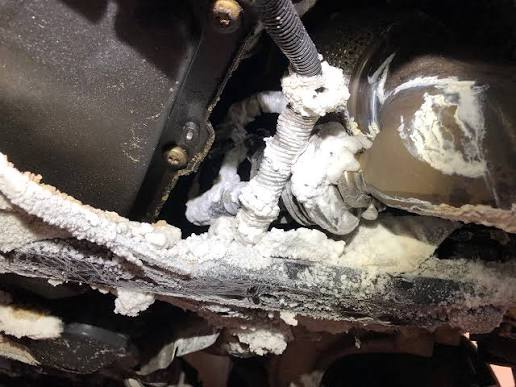
CLIENT_VEHICLE // AUDI_Q3
AdBlue pump failure resulted in full crystallisation of feed lines. Client was quoted £2,400 for full assembly replacement at main dealer. We resolved the issue via ECU software delete — no new parts required.
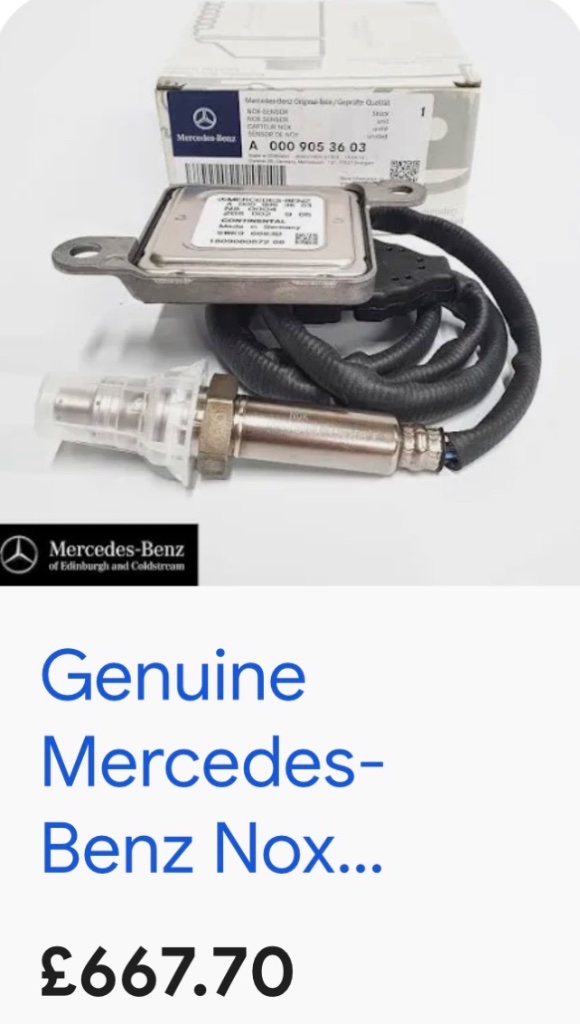
PART_COST // MERCEDES C-CLASS NOx SENSOR
One genuine OEM NOx sensor. Before labour, calibration, AdBlue priming, or VAT. Expect a total bill exceeding £1,000 per sensor — then hope your pump doesn't fail next.
// NOx_SENSORS
NOx Sensors:
Precision Parts. Precision Prices.
The AdBlue system is continuously monitored by the ECU via NOx sensors. A basic system uses a minimum of two: one placed before the AdBlue injector to measure pre-treatment NOx concentration, and one after to verify the reduction is within specification. More complex systems run additional sensors at multiple points.
These are not simple oxygen sensors. A NOx sensor is a precision electronic assembly incorporating ceramic elements, precious metal compounds, and a built-in microcontroller that processes chemical readings and communicates directly with the ECU. They operate in extreme exhaust heat and must maintain calibrated accuracy throughout their service life.
Cheap aftermarket NOx sensors sold on eBay or Amazon cannot perform to the required specification — it's physically impossible to manufacture a correctly-calibrated unit at those prices. We refuse to fit customer-supplied parts because we know it means doing the job twice. Buy cheap, buy twice.
NOx Sensor — Sensor 1 or 2 Circuit Fault. Triggers immediately on sensor failure and initiates the non-start countdown on most platforms.
// DIAGNOSTIC_CODES
Common AdBlue Fault Codes
AdBlue System Malfunction
The AdBlue® system has a malfunction. This is the most common fault code and typically indicates pump failure or a communication fault with the dosing control unit.
AdBlue Extraction Pump — Electrical Fault / Open Circuit
The output for the AdBlue® extraction pump has an electrical fault or an open circuit. Often the first indicator that pump failure is imminent.
NOx Sensor Circuit Fault (Sensor 1 or 2)
A NOx sensor has failed or is outside of its expected operating range. Can be pre- or post-injector. Triggers countdown-to-non-start on most vehicles.
// NON_START_PROTOCOL
Unlike Other Faults —
This One Forces Your Hand
Most vehicle faults allow you time. A warning light comes on, you deal with it when you can afford to. AdBlue doesn't work that way.
Once a fault is detected, your vehicle enters a mileage countdown. The dashboard will display warnings like "Engine will not start in 150 miles" or "No restart in 650 mi". When that counter reaches zero — the vehicle will not start. Full stop.
At that point, you're looking at a recovery truck to get the vehicle to a workshop, adding further costs on top of an already expensive repair. Clients regularly arrive with us on the back of a flatbed having ignored the warnings, or simply run out of time.
Our advice: Do not ignore AdBlue warnings. The countdown is real and the vehicle will not start. Contact us as soon as a fault appears — we can resolve most AdBlue issues via ECU software delete without the need for expensive hardware replacement.
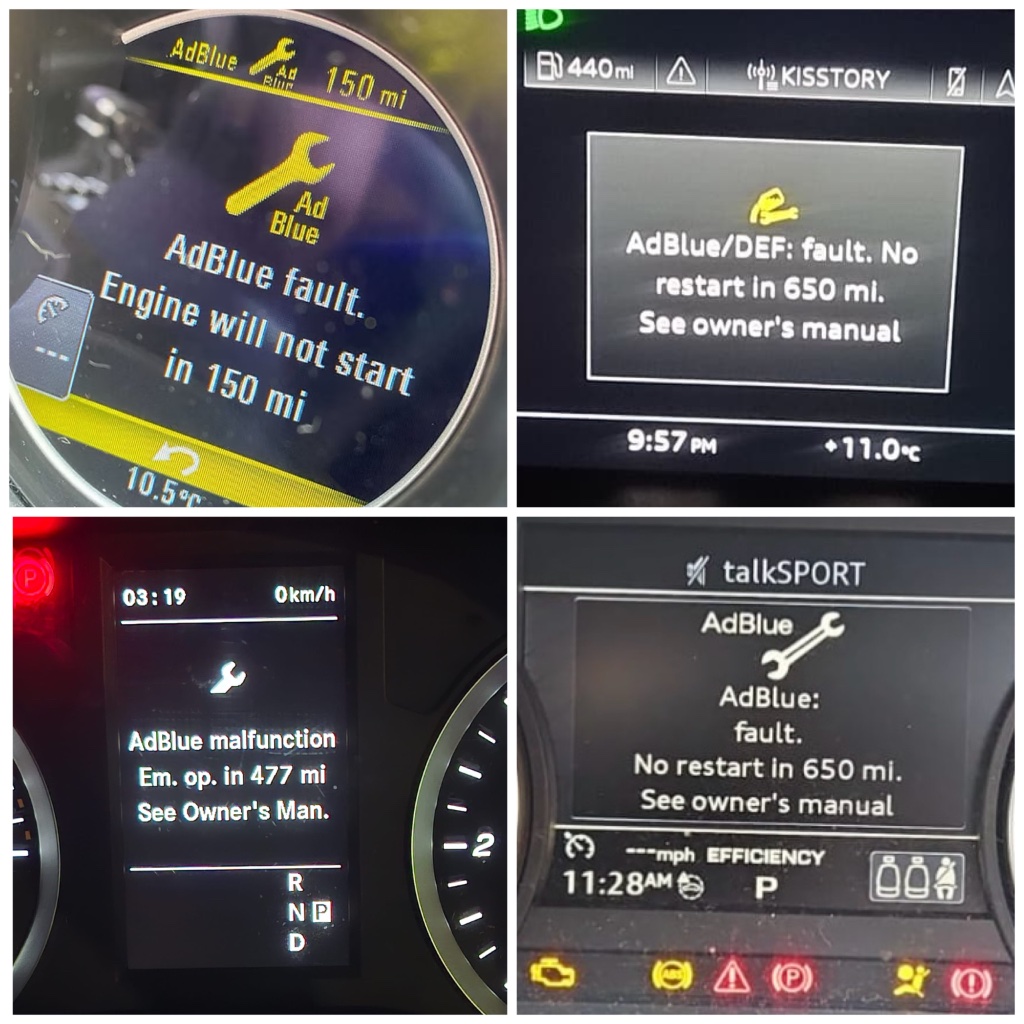
REAL_CLIENTS // NON-START WARNINGS
All four of these vehicles arrived at our workshop with active AdBlue non-start countdowns. All were resolved via ECU recalibration — no hardware replacement required.
// OUR_SOLUTION
Permanent AdBlue Delete.
No Parts. No Countdown. No Return.
Our AdBlue delete is a full ECU software solution. We recalibrate your engine management system to permanently disable all AdBlue monitoring, remove all associated fault codes, and suppress them indefinitely — without replacing a single hardware component.
No more countdown warnings. No risk of non-start. No expensive pump or sensor bills. One visit. Done.
Authored by David Dawud — Master Vehicle Software Engineer · Power & Performance UK