// ADVANCED_DIAGNOSTICS
When Other Garages
Have Given Up.
Most garages are parts swappers. They fit brake pads, change oil, and replace whatever the fault code points at. When a problem is complex — when the cause isn't obvious — they either give up or keep throwing parts at it until they get lucky. We do something different: we actually find the fault.
// THE_PROBLEM
The Part-Swapper Problem
The majority of service garages are trained and equipped for routine maintenance — oil changes, tyres, brake pads, filters. That's what they do. When a complex fault comes in, they plug in a generic code reader, see a fault code, and replace the part it points to.
A fault code is not a diagnosis. It is a symptom. It tells you a system is not performing within parameters — it does not tell you why. Replacing the component named in the code without understanding the root cause is guesswork. Expensive guesswork.
Customers arrive at our workshop having spent hundreds — sometimes thousands — of pounds at other garages with the fault still present. In most cases, the actual repair costs a fraction of what was wasted on unnecessary parts.
// COMMON_PATTERNS_WE_SEE
// OUR_APPROACH
How We Actually Find Faults
A fault code is the starting point, not the answer. Our diagnostic process goes several layers deeper.
OEM-Level Diagnostic Software
We use the same manufacturer diagnostic platforms that main dealers use — not generic code readers. This gives us access to live data streams, freeze frames, adaptation values, and ECU configuration data that aftermarket tools simply cannot see.
Live Data Analysis
Fault codes tell you what system is unhappy. Live data tells you why. We monitor sensor outputs, actuator responses, fuel trims, boost pressures, and injection timings in real time to pinpoint exactly where the system is deviating from specification.
Oscilloscope & Waveform Testing
Electrical faults are invisible to code readers. We use oscilloscope testing to examine the actual electrical signals — injector waveforms, sensor patterns, CAN bus data — to identify broken circuits, failing sensors, and intermittent faults.
System-Level Thinking
We don't replace parts and hope. We trace fault paths through the entire system — fuel, air, ignition, mechanical, electrical — until we find the root cause. Every repair comes with a confirmed fix, not a guess.
// IN_THE_WORKSHOP
Diagnostics in Action
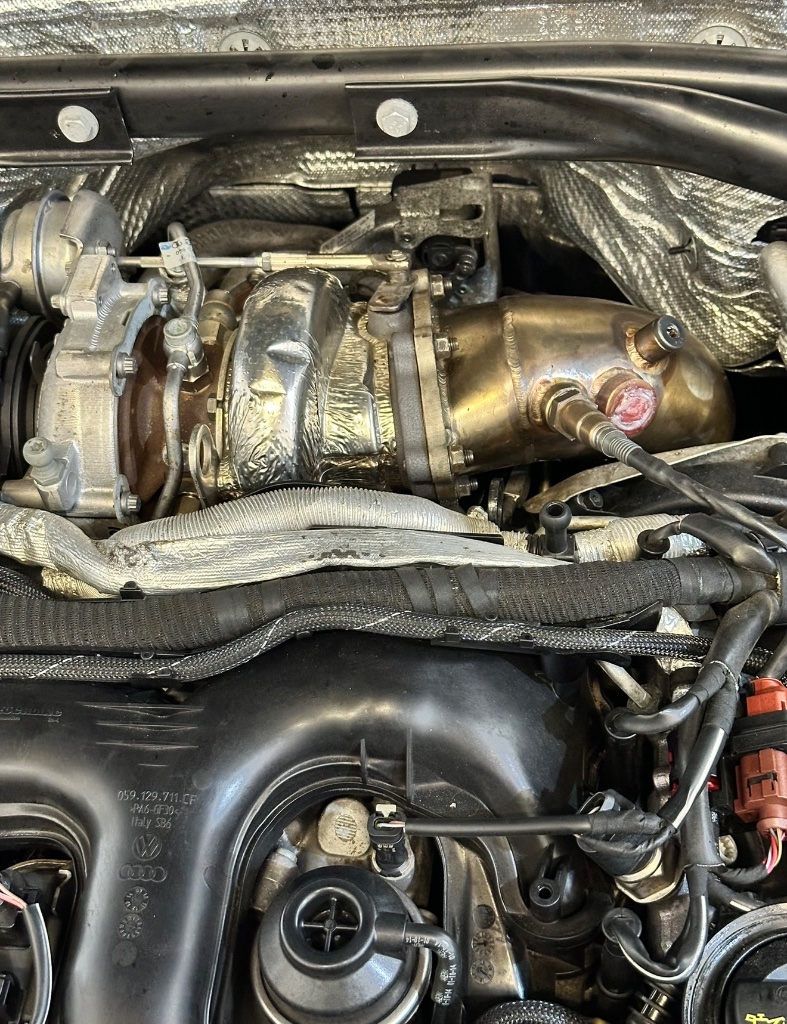
DIAG_01
Turbo system inspection — the kind of root-cause analysis most garages skip
// REAL_CASES
Money Wasted Before They Found Us
These are real examples of vehicles that came to us after other garages had failed to find the fault — and the unnecessary costs those customers had already incurred.
Turbo Replacement That Didn't Fix the Problem
// PARTS_THROWN_AT_IT
// ACTUAL_FAULT
A blocked and collapsed vacuum line to the turbo actuator control solenoid. £12 in parts and 40 minutes of labour.
// FULL_ANALYSIS
The vehicle had been in limp mode with a turbo underboost fault. A previous garage replaced the entire turbocharger assembly without doing live data analysis first. The turbo was never the problem — the actuator had no vacuum signal because the feed pipe had collapsed internally. The ECU couldn't control boost, so it limited power. A new turbo with the same collapsed vacuum line produced exactly the same result.
A fault code pointing to turbo underboost does not mean the turbo is faulty. It means the boost system isn't performing. The root cause requires live data analysis and system testing — not part replacement.
EGR Valve Replaced Three Times — Still Fault Present
// PARTS_THROWN_AT_IT
// ACTUAL_FAULT
A cracked EGR cooler leaking coolant into the intake manifold, causing the new valves to fail immediately on contact with coolant contamination.
// FULL_ANALYSIS
The customer had been told by two different garages that the EGR valve needed replacing. It did — but only because the root cause (a leaking EGR cooler) was destroying every new valve within days. Without identifying the cooler as the source, replacing valves was pointless. We pressure-tested the cooling system, found the leak, replaced the cooler, and the system has been fault-free since.
Replacing the component that triggers the fault code is not the same as finding the fault. If a part keeps failing, something upstream is causing it.
Misfire — New Coils, Plugs, and Injectors Fitted
// PARTS_THROWN_AT_IT
// ACTUAL_FAULT
A fractured wiring loom ground connection causing intermittent signal loss on the cylinder 3 injector circuit. A £0 repair — one repaired connector.
// FULL_ANALYSIS
The misfire was intermittent and always on cylinder 3. The previous garage assumed component failure and replaced everything in the firing chain. Live oscilloscope testing of the injector signal on our equipment showed a broken ground path causing signal dropout. Repaired the connector — misfire gone permanently.
Electrical faults require waveform analysis and circuit testing, not parts. A good diagnostic technician looks at signals, not just codes.
// OUR_PROCESS
What to Expect When You Book a Diagnostic
Full System Scan
We read every module in the vehicle — engine, gearbox, ABS, body — not just the one throwing the code.
Live Data Review
We drive the vehicle or put it under load and monitor live sensor data to replicate and observe the fault in real time.
Root Cause Confirmed
We identify the actual source of the fault — not the symptom. We won't recommend a repair until we're certain.
Transparent Report
You get a clear explanation of exactly what's wrong, why it's happened, and what it costs to fix. No surprises.
Already Had Work Done Elsewhere That Didn't Fix It?
Bring us the full history — what codes were found, what parts were fitted, what symptoms remain. The more context we have, the faster we can identify what's actually happening. We regularly work on vehicles that have been through two or three other garages without resolution.
// STOP_GUESSING
Done Paying for Parts
That Don't Fix It?
Book an advanced diagnostic session and we'll find the actual fault — not the symptom. One diagnostic. One correct answer. One repair.